A soft summer capsule wardrobe should make an ordinary week easier to dress for. A row of beautifully coordinated clothes is less useful if none of the trousers fit comfortably, the only jacket needs special care or every top is waiting for laundry. Start with what you own and what you actually do. The soft summer label describes a subjective approach to muted, often cool-leaning colors; it is a styling aid, not a scientific diagnosis or a rule about who may wear a color. Your working capsule can include favorites that sit outside it.
Count usable combinations before buying
Take a small capsule inventory from clothes you have worn recently. Record each item's role: a bottom, a top, a layer or footwear. Add fit, condition and care needs beside the color. A gray cardigan with stretched cuffs is not the same resource as one you are happy to wear to work. A skirt that needs different underwear or shoes may still be useful, but those requirements belong in the inventory too.
Build complete outfits on your body rather than counting mathematical possibilities on a bed. Three tops and two trousers suggest six combinations, but a long shirt may bunch inside one waistband and a cropped knit may feel wrong over the other pair. Put each promising combination on with shoes, sit down and move your arms. Count only the outfits you would realistically wear for a named activity. This is slower than multiplying garment numbers and much more revealing.
Use an outfit matrix if remembering the results gets awkward. Write your bottoms across the top of a page and your tops down one side. Mark a pairing only after trying it, then add the layer that finishes it. A pale gray shirt might work with navy trousers alone but need a charcoal cardigan with the rose brown skirt. That small note preserves the useful detail that a simple check mark would miss.
The inventory may show that your favorite bright sweater belongs in the capsule despite its color. Keep it if it works with the trousers and shoes you use most. Conversely, a perfectly muted blouse may earn no place if its neckline bothers you or it requires care you avoid. The aim is a group of usable clothes with good connections. Color can improve those connections, but it does not make an uncomfortable garment practical.
Pick two connecting neutrals
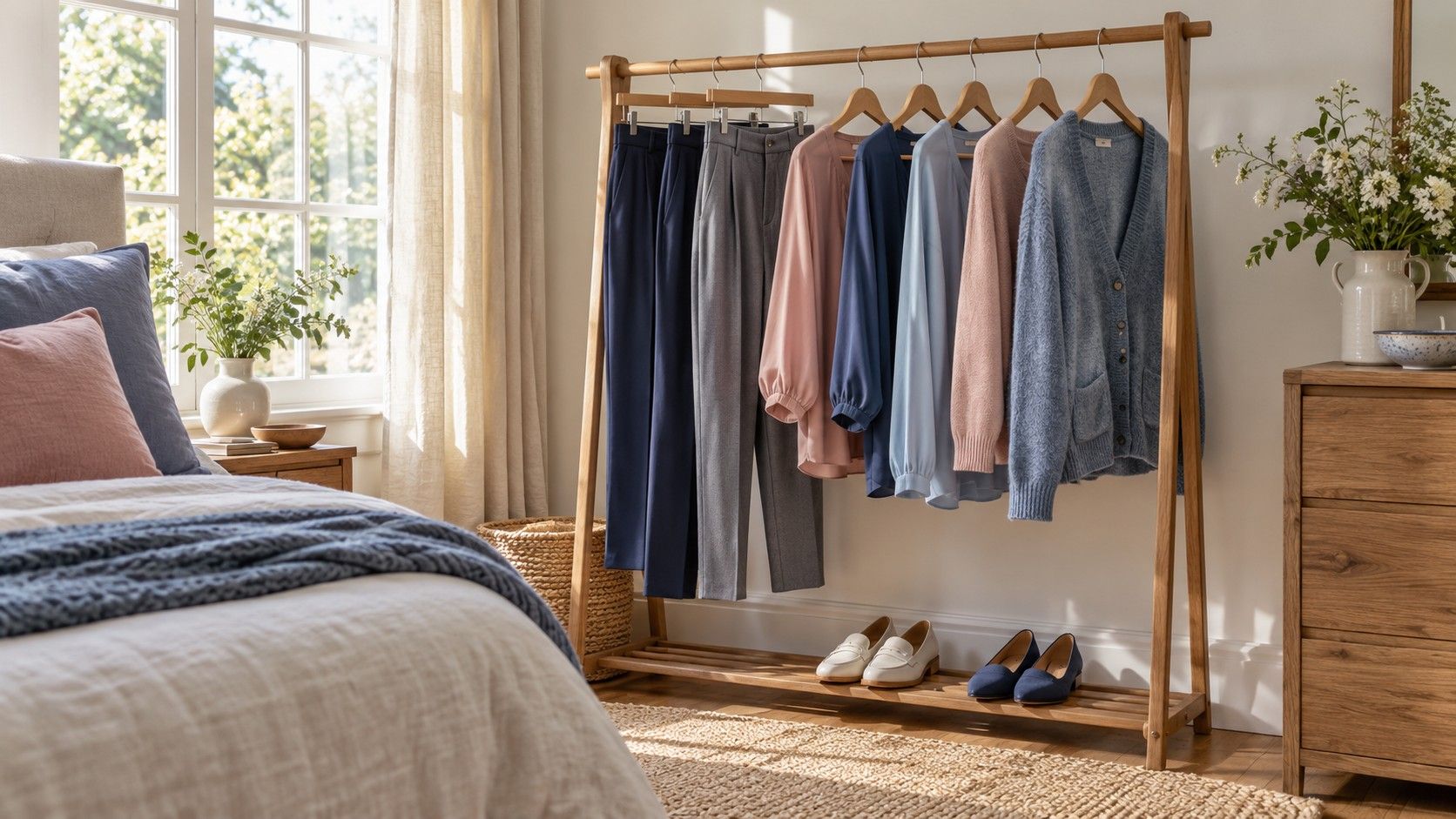
Two familiar neutrals can give the wardrobe a clear structure. Consider washed navy and medium gray if those colors already occur in your clothes. Navy trousers might pair with gray knitwear, while gray trousers use the same navy jacket. If rose brown and charcoal are better represented, begin there instead. There is little value in naming an ideal neutral that would require replacing most of the wardrobe.
Compare the actual garments side by side near a window. Muted neutrals have undertones that become more obvious together: a taupe top may look beige beside gray and pinkish beside brown. You do not need every item to match exactly. Look for pairs that seem comfortable to your eye and enough difference in lightness to show the layers. A gray top and gray cardigan can work well when texture or depth gives each a clear edge.
Check the shoes and outerwear before committing to the pair. If every useful shoe is brown and the only weatherproof coat is olive, a capsule assembled solely around icy gray may take more effort than expected. Try the coat over your two strongest outfits with the shoes you actually walk in. You might discover an existing rose brown scarf connects them, or simply decide that a warmer accessory contrast suits you.
For a compact group, repeat a neutral in more than one role. Medium gray could appear in a cardigan and skirt; navy could appear in trousers and a casual jacket. Repetition lets a layer move between outfits without needing an exact duplicate shade. Watch fabric weight as closely as color, though. A substantial winter cardigan will not become a useful summer layer because it coordinates perfectly with lightweight trousers.
Choose accents that cross the wardrobe
An accent earns its place when it works in several familiar combinations. Try a dusty rose shirt with both neutrals, then with your denim. Repeat the test with smoky blue or muted plum if you own them. Choose the color you enjoy wearing and the garment whose cut works most readily. A beautiful shade in a difficult blouse can make the capsule feel like a puzzle every morning.
Keep the initial accent group small enough to compare honestly. Two or three colors may be enough for a trial week; this is a working limit, not a universal capsule rule. A gray cardigan over a dusty rose top and navy trousers gives one outfit. Move the cardigan over a smoky blue top with gray trousers for another. If both tops also work alone with jeans, their value extends beyond the office without adding separate weekend clothes.
Prints can connect accent colors without requiring several extra garments. A scarf containing gray, blue and muted rose may sit comfortably with either neutral. Test it around your neck or on the intended outfit, because a print that looks subtle when folded can feel busy when spread out. Avoid assigning a special connecting role to an accessory you dislike wearing. A plain layer is often the more useful answer.
Test a small working week capsule
Choose a real week with a reasonably typical schedule. Set aside two comfortable bottoms, several tops, one or two suitable layers and shoes for the activities ahead. The number depends on washing habits and how much your clothes need changing. A person cycling to work or looking after young children may need more washable tops than someone spending the week at a quiet desk. Begin with your actual routine.
Plan Monday's outfit completely, including the coat if needed. Gray trousers, a smoky blue shirt, a navy jacket and gray shoes could cover an office day. For Tuesday, use the same trousers with a dusty rose knit and a cardigan only if the room requires it. On a more casual day, switch to denim and keep the knit. Reusing a garment is useful when it remains clean and comfortable; a capsule should not create pressure to ignore that check.
Leave one outfit ready for a sudden change of plan. This might be a dark skirt, a plain gray top and clean shoes for an evening event, or jeans and a washable layer for a wet afternoon. Try it before the week begins. Finding that the top catches at the waist five minutes before leaving is a fit problem, not evidence that you chose the wrong color season.
At the end of the trial, record what actually happened. Perhaps the navy jacket never left the hanger because the weather stayed warm, while the gray cardigan was worn three times. Note pieces that needed adjustment, outfits you repeated willingly and laundry that interrupted the plan. Keep a few quick outfit photos if helpful, using similar light. The record is a memory aid; phone processing can change subtle colors considerably.
Handle laundry seasons and wardrobe gaps
Laundry rotation sets the practical size of the capsule. If you wash once a week and cannot comfortably rewear tops, allow enough clean ones for that interval plus a reasonable spare. Drying time matters as well. A thick knit that takes two days to dry cannot fill the same role as a quickly drying cotton layer. Check care labels and your own washing setup before assuming that two visually similar pieces are interchangeable.
Separate weather gaps from color gaps. If all your outfits work indoors but none handles rain, another muted blouse will not solve the problem. A useful waterproof layer or shoes you can walk in may already be elsewhere in the wardrobe. Bring them into the trial and assess the combination. A soft summer wardrobe can accommodate a practical coat outside the preferred palette; comfort in the actual weather is a sound reason to keep it.
When a gap persists, describe it by function before color. Write 'washable top that works with both trousers and fits under the cardigan' rather than only 'dusty rose top.' Check whether an existing garment could fill the role after a simple repair, a different tuck or a better layering choice. For a piece you already own, cost per wear is a retrospective clue to use: dividing its price by actual wears helps reveal what has served you, without predicting future habits.
Review the capsule when the season changes rather than rebuilding it at every shift in temperature. Keep the successful combinations and exchange weights gradually: a lighter gray layer for a heavier one, or a short-sleeved top for a long-sleeved version if available. Store a short note of what worked. A small wardrobe becomes easier through repeated, observed use, and its best color choices are the ones that help you wear useful clothes with less hesitation.