Men’s clothing color combinations are easier to judge when you build from the trousers and the occasion. Navy chinos with a pale shirt and brown shoes solve a different problem from black jeans, a dark T-shirt and trainers. Color matters, but fabric, fit and shoe formality decide whether the pieces feel comfortable together. Start with the clothes you already wear and change one element at a time. A small set of complete combinations is more useful than a complicated list of colors that supposedly suit every man or every complexion.
Start with trousers and the level of formality
Choose the bottom half first because it sets a large color area and often fixes the outfit's practical limits. Navy chinos can work with an Oxford-style shirt for a relaxed office, or with a T-shirt and shirt jacket for a casual day. Charcoal tailored trousers usually suggest a more polished direction, while faded jeans bring a different surface and mood. Check the actual workplace or event expectations before using any of these as a formula.
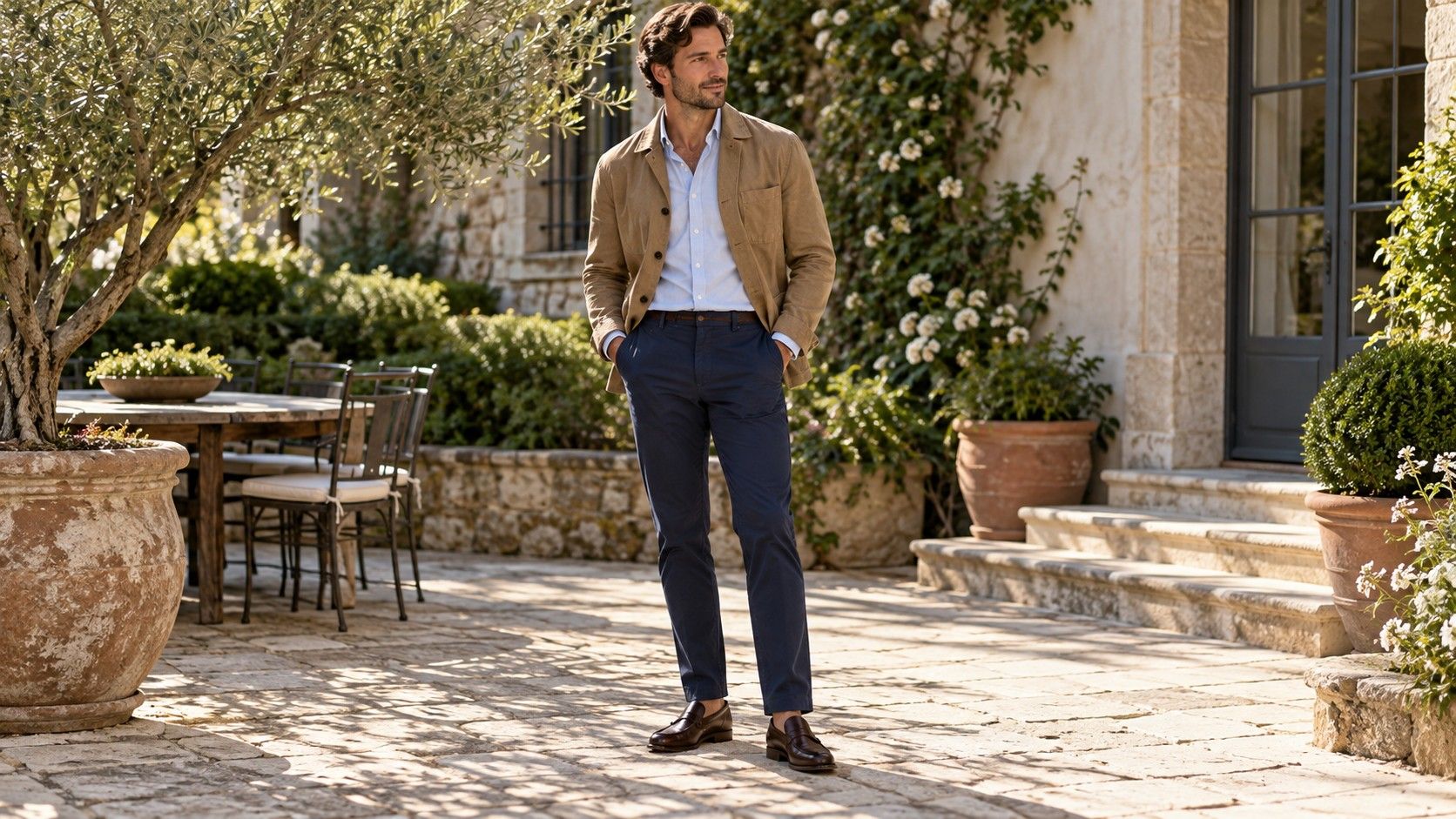
For a workday without a suit requirement, try navy chinos, a pale blue shirt and dark brown leather shoes. The fabric matters: clean, structured chinos sit differently beside a dress shirt than heavily washed, rumpled cotton. If the combination feels uneven, try a less formal shirt or a knit layer before changing its colors. A mismatch of formality is easy to mistake for a color problem.
On a casual day, medium-wash jeans, a white T-shirt and an olive shirt jacket give a straightforward base. Wear the jacket open and check how much of the T-shirt shows. A long shirt jacket over a long T-shirt can feel heavy, while a shorter underlayer creates a clearer edge. Those proportions may matter more than choosing between two nearly identical shades of olive.
Inspect trouser length with the intended shoes. A heavy stack of fabric over a neat shoe changes the silhouette; a short hem reveals more sock and creates another color break. Adjust a cuff if appropriate, then look at the whole outfit from a normal distance. Keep the trousers that fit comfortably through sitting and walking. A versatile color will not compensate for a waistband or rise that makes the day awkward.
Choose a shirt with enough separation
A shirt needs enough separation from the trousers for the result you want. Pale blue over navy gives an obvious difference in lightness without an extreme contrast. White over black looks sharper. Dark gray over black produces a quieter division that relies more on texture and silhouette. Try two shirts with the same trousers and shoes so you can see which level of contrast feels right for the setting.
For a softer combination, wear an off-white shirt with olive trousers and brown shoes. For a more graphic option, put a bright white shirt with charcoal trousers and black shoes. Neither is a universal rule for skin tone. Compare the shirts near the face in natural light, then with the entire outfit. A favorite neckline or better drape can influence the result, which is a good reason to test garments rather than abstract swatches.
Dark shirts can work with dark trousers when the pieces have visible differences. An ink navy cotton shirt and black jeans may look intentional if their surfaces and depths separate clearly. Check them together in daylight and under indoor light. If they seem like an awkward near-match to you, try gray trousers or a lighter layer. There is no need to insist that two dark colors must always work or must never be worn together.
Tucking changes the color balance as well as the shape. A fully tucked shirt exposes more trouser and the belt; an untucked one covers a larger area and may interrupt the leg line. Check its length from the side and back. A shirt designed with a long curved hem can feel different worn loose from a shorter casual shirt. Settle that practical question before deciding an otherwise useful color combination has failed.
Make jacket and shirt patterns coexist
A plain shirt is a useful starting point under a patterned jacket because it leaves the pattern easy to read. Try a pale blue shirt with a navy checked jacket and gray trousers, if those pieces are already in your wardrobe. Look at the combination from several steps away. The check might become subtle at that distance, or it may remain the outfit's main feature. Let that observation guide whether another pattern adds anything.
If both layers are patterned, compare their scales. A small stripe on a shirt beneath a broader jacket check can be easier to distinguish than two dense patterns of similar size. Keep the trousers plain during the test. Pattern scale is a practical comparison rather than a guarantee: strongly contrasting lines or unusual color combinations may still compete. Wear the layers together and check the overall effect instead of relying on the hanger view.
Texture deserves the same attention as print. A coarse shirt jacket over a smooth T-shirt can look balanced because their surfaces differ; a thick textured shirt under a close-fitting jacket may feel bulky. Move your arms, sit down and check the collar. A pattern combination that looks attractive but keeps bunching at the neck is unlikely to become a reliable outfit. Comfort is part of whether the clothes work together.
Settle shoes belts and socks
Choose shoes that fit both the activity and the clothes' level of formality. A dark leather lace-up can support charcoal trousers and a shirt in a way that a bulky running trainer may not. Clean simple trainers can work with chinos in many casual settings, but an event's dress expectations still come first. Shoe formality is about shape, materials and condition as well as color. Try the intended pair before calling an outfit finished.
For a simple starting point, use black shoes with charcoal trousers and a white or pale blue shirt. Dark brown shoes with navy chinos give another familiar combination. These are useful experiments, not restrictions: burgundy leather can also work with navy, while brown shoes may appeal beside gray. Compare the actual leather tone in daylight. Very orange-brown leather creates more contrast than a darker, quieter brown even though both are called brown.
A leather belt in a similar general tone to the shoes can connect the outfit, especially when the shirt is tucked. An exact finish or shade match is rarely necessary for ordinary casual dressing. If the belt is noticeably brighter, check whether you enjoy the emphasis at the waist. A fabric belt may suit a casual combination better than polished leather. Use what supports the clothes' character and fits securely.
Socks can continue the trouser color for a quieter transition, echo a shirt color or introduce a small accent. Test the seated view, where more sock becomes visible. A bright sock that seemed insignificant while standing can become a prominent block above a dark shoe. Choose deliberately, then check comfort and coverage. No color choice helps if the socks slip or the shoes hurt after a short walk.
Build five useful combinations from a small rail
Select two useful bottoms, several tops and two layers from your existing wardrobe. Navy chinos and charcoal trousers could anchor a group with white and pale blue shirts, a gray T-shirt, an olive shirt jacket and a navy knit. This is an example of a color palette for men clothes that can be tested, not a required inventory. Substitute your most comfortable equivalents rather than trying to reproduce every piece.
For the first combination, try navy chinos, a pale blue shirt and dark brown shoes. For the second, use the chinos with the gray T-shirt, olive shirt jacket and casual trainers. The same bottom serves two different levels of formality because the supporting pieces change. Check that the trainers work with the hem and that the shirt jacket sits comfortably over the T-shirt. Record only combinations you would use.
A third outfit could pair charcoal trousers with the white shirt and black shoes. For a fourth, put the navy knit over that shirt, leaving the collar visible if it sits comfortably. The fifth could use navy chinos with the knit and a plain underlayer for a quieter casual look. Compare each complete outfit with your actual coat and bag. An outer layer can change the color balance more than a small accessory does.
Wear the combinations through a typical week and note the weak point in each. Perhaps the white shirt needs more care than your routine allows, or the knit is too warm indoors. Change that piece before expanding the rail. Repeating successful clothes color combinations for men reduces morning decisions, while leaving room for a stronger shirt, a different leather tone or a pattern when you feel like varying the familiar base.